
AI is disrupting established careers while creating demand for a different kind of technical specialist. Here’s what forward-deployed engineers do, why companies need them, and how to get started.
Artificial intelligence is disrupting the labor market, and there is little reason to assume the jobs it creates will compensate for those it eliminates. The eventual balance remains uncertain.
But technological disruption also creates opportunities for people who recognize emerging needs and develop the skills to address them.
Forward-deployed engineering is one example.
The profession has existed for years, notably at companies such as Palantir, but demand has accelerated as organizations move from experimenting with AI to implementing it in their operations. According to data reported by Business Insider, U.S. job postings for forward-deployed engineers increased 729% between April 2025 and April 2026.
Compensation reflects the demand. An October 2026 analysis by Top FDE Jobs found a median advertised U.S. base salary of approximately $200,000 across positions reporting compensation. These are predominantly experienced engineering roles, not entry-level opportunities.
For technically capable, entrepreneurial people prepared to acquire the necessary skills, this is a field worth exploring.
What Is a Forward-Deployed Engineer?
A forward-deployed engineer (FDE) works directly with customers to implement technology within their existing business environment.
Unlike a traditional software engineer, who may spend most of their time developing a product for a broad customer base, an FDE works on the specific challenges of an individual organization.
The role combines software development, systems integration, infrastructure engineering, and technical consulting.
Consider a company that wants to deploy large language models entirely within its own infrastructure, behind its corporate firewall.
The organization may want employees to analyze technical documents, search proprietary information, automate workflows, or interact with internal applications without sending sensitive information to external model providers.
The models themselves are increasingly accessible. Making them work reliably within the customer’s environment is considerably more complicated.
That is where the FDE comes in.
The Technology Is Moving Quickly
Open-weight language models have advanced remarkably over the past two years.
Model families such as Qwen, DeepSeek, Kimi, Llama, Gemma, and Mistral now offer sophisticated reasoning, coding, document analysis, and other capabilities.
Some are small enough to operate on a high-performance workstation. Others require substantial GPU infrastructure.
Their architectures also differ. Mixture-of-experts models, for example, activate only a portion of their parameters during inference, improving computational efficiency while retaining access to much larger collections of model weights.
Enterprise adoption is increasing. Futurum Research reported that 42% of organizations in its September 2026 survey were running open-weight models in production, compared with 31% in July. The survey covered 200 organizations and is not necessarily representative of the broader market.
For FDEs, the important development is that companies have more options than ever. They need people who understand how to evaluate those options and implement them effectively.
A Field Guide: Your First Enterprise Deployment
Imagine arriving at a company that wants to deploy an LLM behind its firewall.
Where do you begin?
1. Understand the Business Requirement
Before discussing models or hardware, determine what the organization wants to accomplish.
What business process will the system support? What information must it access? How will employees interact with it? What constitutes a successful result?
An application extracting structured information from documents has different requirements from one performing complex technical analysis.
The engineer should establish measurable expectations for accuracy, response time, and reliability before designing the solution.
2. Assess the Existing Infrastructure
Next, understand what the organization already has.
Identify available GPUs, memory, servers, operating systems, storage, networking, and security controls.
Determine whether the environment supports containers, internal APIs, and the software required to operate an inference engine.
A particularly important question is whether the environment permits any external connectivity.
In a fully isolated deployment, model weights, software dependencies, containers, and updates must enter through controlled processes.
3. Select and Size the Model
Model selection requires balancing capability, memory consumption, performance, and licensing.
Consider NVIDIA’s RTX 5090, which has 32 GB of graphics memory.
A dense 32-billion-parameter model requires approximately 64 GB to store its weights at 16-bit precision. At 4-bit precision, the theoretical weight requirement falls to approximately 16 GB, although runtime overhead increases actual memory consumption.
Quantization can therefore make larger models practical on smaller hardware, provided testing confirms that output quality remains acceptable.
Concurrency complicates the calculation.
A configuration that performs well with one active request may struggle with five. At twenty simultaneous tasks, throughput, latency, and request scheduling can become major constraints.
The engineer must size the infrastructure for the expected workload, not simply determine whether the model fits in memory.
4. Integrate the Model With Enterprise Systems
A functioning model is not yet a useful enterprise application.
It must connect to existing databases, document repositories, business applications, and identity systems.
Three techniques can improve efficiency considerably:
- Model selection and quantization: Use the smallest model that reliably meets the application’s requirements.
- Targeted retrieval: Retrieve relevant information rather than repeatedly sending entire documents to the model, reducing unnecessary context and processing.
- Intelligent orchestration: Direct different tasks to appropriate models and tools instead of treating every request identically.
The engineering challenge is to implement these techniques without compromising accuracy, security, or maintainability.
5. Validate Before Production
A successful demonstration proves that something can work. It does not establish that the system is ready for production.
Test with representative documents, realistic workloads, and multiple simultaneous requests.
Measure response latency, throughput, GPU utilization, and output quality.
Common failures include inadequate hardware capacity, unreliable document retrieval, improperly configured access controls, and model outputs that appear convincing but are incorrect.
Establish monitoring, update procedures, and recovery plans before handing the system over to the customer.
The goal is a dependable operating capability, not an impressive demonstration.
How to Get Started
For someone considering this career, the most useful preparation is practical experience.
A software engineering background is valuable, particularly experience with Python, Linux, APIs, databases, and containerized applications. Familiarity with enterprise security, networking, and systems integration is equally useful.
Start by deploying an open-weight model locally using an inference platform such as Ollama or vLLM.
Connect it to a simple application. Add a document repository and implement retrieval. Measure performance as you increase the length and number of requests.
Experiment with different models and quantization levels. Observe how memory consumption, throughput, and response times change.
Then consider how you would deploy the same system inside a corporate environment with restricted networking, authentication requirements, and existing business applications.
This progression develops the skills employers need: understanding customer requirements, writing working software, integrating systems, diagnosing problems, and delivering measurable results.
A Practical Resource: The GPU Capacity Planner
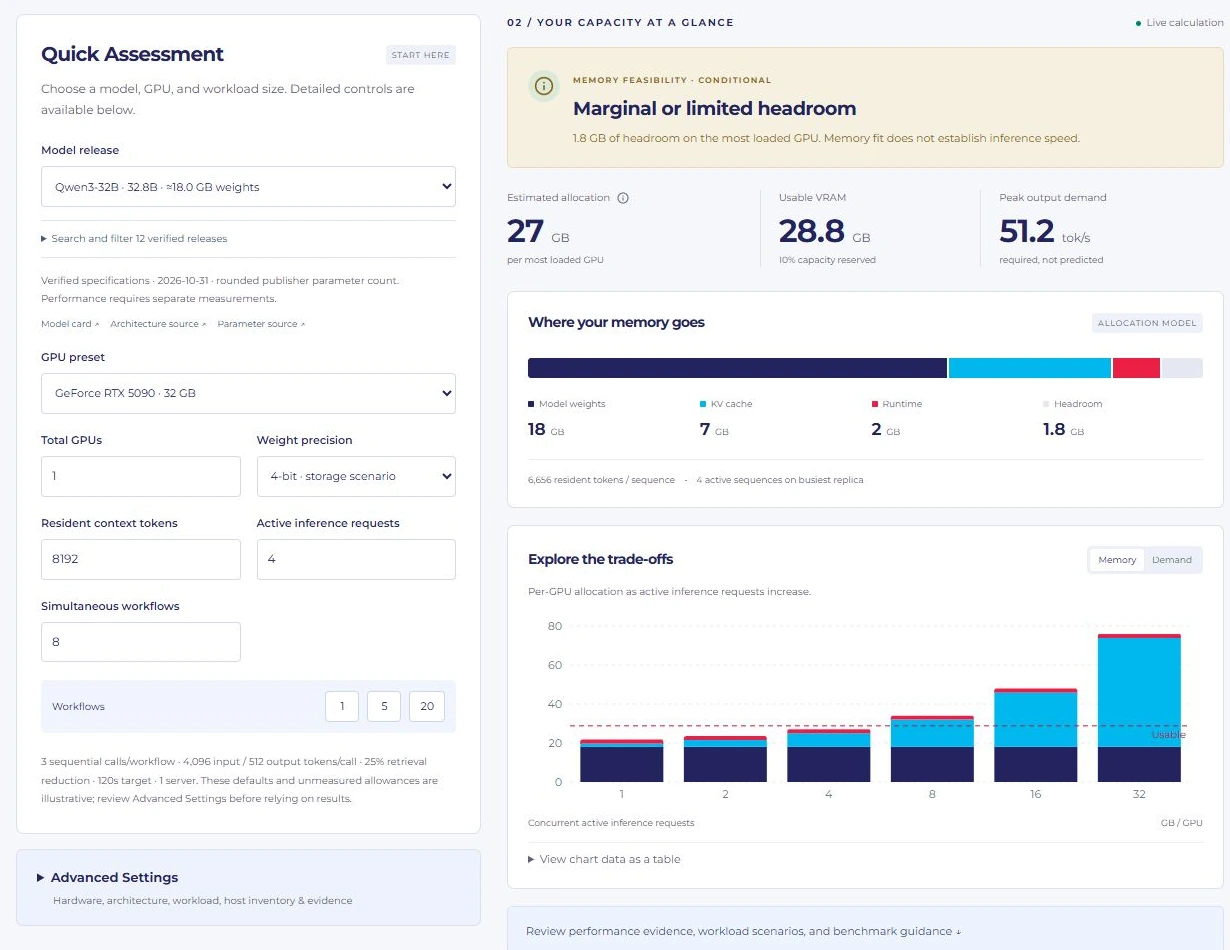
To help people explore the infrastructure requirements of on-premises LLM deployments, Rise Up Strategies has developed a free, interactive GPU Capacity Planner.
The tool allows you to experiment with model configurations, GPU hardware, quantization, and concurrent workloads.
It provides a starting point for understanding the relationship between model capability and infrastructure requirements.
The calculator provides planning estimates, not guaranteed production performance. Real deployments still require benchmarking.
Finding Opportunity in Disruption
Nobody knows precisely how artificial intelligence will reshape employment. Some occupations will change substantially, others may disappear, and new specializations will emerge.
Forward-deployed engineering illustrates how demand can develop around the practical challenges of adopting new technology.
The profession is not entirely new, nor is it an easy entry point for someone without technical experience. But its growing importance reflects a genuine business need.
Companies have access to increasingly powerful models. They need people who can make those models work within the complexity of real organizations.
For those with the technical foundation, curiosity, and willingness to work directly with customers, forward-deployed engineering offers a promising direction to investigate.
The opportunity lies in understanding the technology well enough to make it useful.
