
For the past several years, enterprise AI strategy has focused heavily on model capability.
Organizations have compared benchmark performance, reasoning ability, context windows, coding results, latency, cost, and conversational quality. Model selection often served as the starting point for evaluating an AI product or planning an enterprise deployment.
That approach reflected the first phase of generative AI adoption. Most early use cases supported individuals performing discrete tasks such as summarization, drafting, search, coding, and content generation. The model played a highly visible role in the user experience, so improvements in model quality often produced immediate gains.
Enterprise use is now expanding into engineering, legal review, cybersecurity, quality management, customer operations, product development, regulatory affairs, financial analysis, and executive decision support. These workflows place AI inside processes that carry operational, financial, legal, and reputational consequences.
This expansion changes the criteria used to evaluate enterprise AI.
Organizations need to understand where their data travels, how enterprise knowledge is protected, how outputs can be verified, how access is governed, and how AI-supported decisions can be reviewed. They also need flexibility when model providers change pricing, licensing, deployment options, or technical direction.
These requirements are shaping the architecture of enterprise AI systems.
Trust now depends on the complete system surrounding the model, including knowledge management, orchestration, evidence, governance, security, deployment, and integration with existing enterprise workflows.
From Model Selection to System Design
Enterprise AI is developing into a form of organizational infrastructure.
Infrastructure supports repeated use across teams, processes, and systems. It must remain reliable as workloads grow, vendors change, risks evolve, and organizational requirements become more complex.
This places greater emphasis on several practical questions:
- Can the organization change models without rebuilding its applications?
- Can different models handle different workloads?
- Can the system use proprietary knowledge without surrendering control of that knowledge?
- Can users trace an output to supporting evidence?
- Can administrators apply consistent identity, access, retention, and security policies?
- Can the system operate in cloud, private cloud, on-premises, or restricted environments?
- Can the organization preserve the knowledge and decisions generated through years of AI use?
The quality of an enterprise AI deployment increasingly depends on how these questions are addressed together.
A highly capable model can improve system performance, but the model represents only one layer. Durable enterprise capability emerges from the way models interact with data, knowledge, tools, policies, users, and decision processes.
Enterprise Knowledge as Infrastructure
Every organization accumulates knowledge through its operations.
That knowledge includes technical documentation, research, policies, procedures, customer history, quality records, project decisions, regulatory interpretations, lessons learned, and the practical expertise held by employees.
Traditional enterprise systems store portions of this information across document repositories, databases, email, collaboration platforms, and specialized applications. The information often remains fragmented, difficult to retrieve, and disconnected from the context in which decisions were made.
AI creates an opportunity to make this knowledge more accessible and useful across the organization. Realizing that opportunity requires a knowledge layer designed around ownership, permissions, provenance, currency, and context.
The knowledge layer should preserve the relationship between information and its source. It should recognize which documents are authoritative, which policies are current, which records apply to a specific business unit, and which users can access particular information.
It should also retain the history behind organizational decisions. A final document rarely captures the alternatives considered, the evidence reviewed, the assumptions applied, or the reasons a particular course was selected.
An enterprise AI system becomes more valuable over time when it can preserve and reuse this institutional context. Each project, review, investigation, and decision can strengthen the organization’s accumulated intelligence rather than disappearing into isolated files and conversations.
Models as Interchangeable Components
Frontier models continue to improve rapidly. Their relative strengths also vary by workload.
One model may perform well on complex reasoning. Another may offer better latency or lower cost. A specialized model may outperform a general-purpose system within a narrow technical domain. An open-weight model may provide deployment or control advantages for a particular use case.
Enterprise architecture can accommodate this variation through a separation between the model layer and the broader application environment.
Model orchestration provides the mechanism for selecting and coordinating models based on task, risk, cost, latency, data sensitivity, and deployment constraints. It can also support fallback options, testing, monitoring, and gradual migration as new models become available.
This approach reduces the operational impact of changes in the model market. Applications, enterprise knowledge, workflows, and governance controls can remain stable while the underlying models evolve.
The organization gains greater freedom to adopt improved capabilities without repeatedly rebuilding the systems that connect AI to its business processes.
Evidence and Decision Support
Enterprise AI is increasingly used to inform decisions rather than simply generate content.
Decision support requires a stronger connection between an output and the information used to produce it. Users need access to sources, assumptions, relevant records, and the reasoning structure behind a recommendation.
Evidence architecture can include:
- source citations
- document-level traceability
- version and date information
- confidence indicators
- structured comparisons
- review and approval workflows
- records of human intervention
- audit histories
- links between recommendations and governing policies
These capabilities allow users to evaluate the basis of an output and determine whether it is suitable for the decision at hand.
They also help organizations distinguish between information retrieval, analysis, recommendation, and authorization. An AI system may assemble evidence and propose a course of action, while designated employees retain responsibility for approval.
This separation supports accountability and makes AI easier to incorporate into established quality, legal, regulatory, and operational processes.
Governance Across the Stack
Governance works most effectively when it is designed across the complete AI environment.
Identity and access controls determine who can use particular applications, models, tools, and knowledge sources. Data policies determine what information may enter the system and where it may be processed. Monitoring detects inappropriate use, anomalous behavior, security events, and declining performance.
Governance also includes decisions about model approval, evaluation, retention, human oversight, vendor management, and acceptable use.
A fragmented approach can produce inconsistent controls across departments and applications. A shared enterprise layer creates a more coherent foundation for policy enforcement while still allowing individual teams to configure workflows for their own needs.
This architecture supports broader adoption because employees, customers, auditors, and executives can understand how the system operates and where responsibility resides.
Deployment as an Architectural Choice
Enterprise deployment requirements vary widely.
Public cloud services may suit organizations prioritizing speed and scalability. Private cloud environments can provide additional isolation and control. On-premises or air-gapped deployments may be necessary when data sensitivity, national requirements, customer commitments, or operational conditions restrict external processing.
A flexible enterprise AI architecture allows deployment decisions to reflect the organization’s requirements.
This flexibility also supports different configurations within the same enterprise. A company may use public cloud models for low-risk productivity tasks, private environments for proprietary knowledge, and locally deployed models for highly sensitive or latency-critical workflows.
Consistent orchestration, governance, and evidence layers can connect these environments without forcing every workload into the same technical model.
The Enterprise AI Stack Is Being Rewritten
Viewed together, these developments represent a significant change in enterprise AI architecture.
The evolution can be understood as a shift in where enterprise value resides.
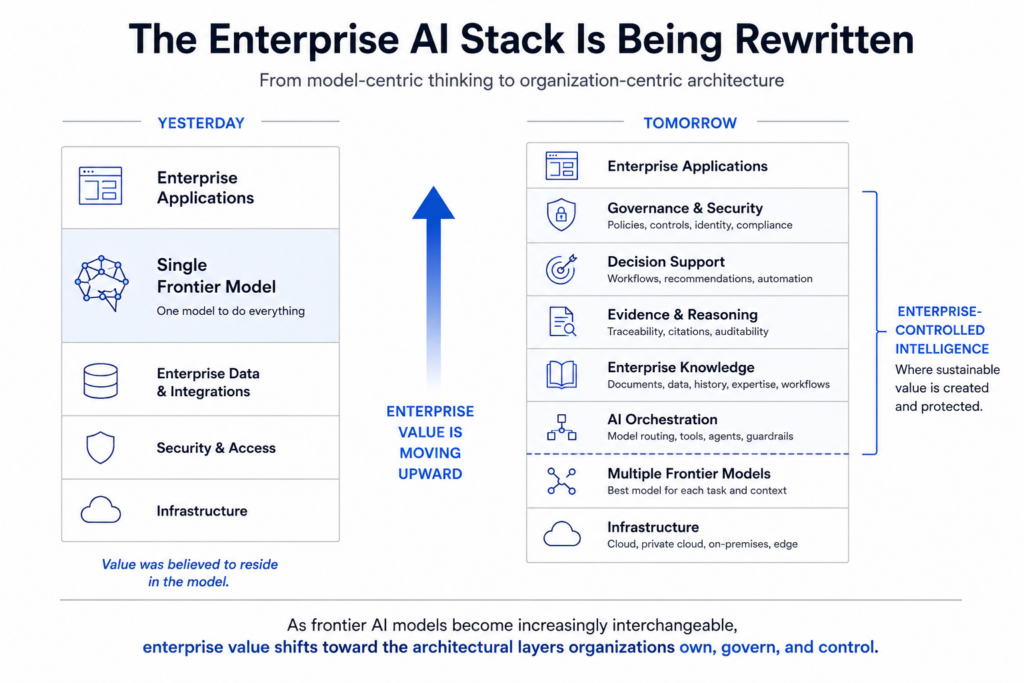
Early enterprise AI deployments concentrated value in the frontier model. Applications connected users to a model, while enterprise data, access controls, and infrastructure supported the interaction.
The emerging stack distributes value across a larger set of enterprise-controlled layers:
- Infrastructure provides the computing and deployment environment.
- Frontier models supply general and specialized AI capabilities.
- AI orchestration routes tasks, coordinates models and tools, applies guardrails, and manages fallbacks.
- Enterprise knowledge connects AI to proprietary data, documents, history, expertise, and workflows.
- Evidence and reasoning support traceability, verification, review, and auditability.
- Decision support embeds analysis and recommendations into operational processes.
- Governance and security apply policies, permissions, identity, compliance, monitoring, and control across the system.
- Enterprise applications deliver these capabilities through the tools and workflows employees already use.
Strategic value accumulates in the layers that an organization owns, governs, and improves over time. Models can change while enterprise knowledge, decision history, governance, integrations, and workflows remain part of the organization’s durable capability.
From Enterprise Knowledge to Organizational Capability
The long-term value of enterprise AI will depend on whether it improves the organization itself.
An isolated assistant may help an employee complete a task more quickly. An enterprise AI system can preserve the knowledge created during that task, connect it to prior work, apply relevant policies, identify supporting evidence, and make the resulting insight available to authorized users across the organization.
This creates a compounding effect.
Each completed project can enrich the knowledge base. Each reviewed recommendation can improve future decision support. Each policy interpretation can become available within the appropriate context. Each approved workflow can provide a repeatable pattern for similar work.
The organization develops a stronger capacity to retrieve its knowledge, apply its expertise, and make consistent decisions.
This organization-centric perspective changes the role of the model. The model provides an important reasoning and language capability within a system designed to strengthen institutional memory, operational consistency, and decision quality.
Looking Ahead
Frontier models will continue to improve, and access to strong model capabilities will become increasingly widespread.
Enterprise outcomes will depend on the architecture built around those capabilities.
Organizations will need systems that preserve proprietary knowledge, coordinate multiple models, produce traceable evidence, enforce governance, support flexible deployment, and integrate AI into accountable decision processes.
The resulting enterprise AI capability can remain durable even as individual models, vendors, and technical approaches change.
Trust provides the foundation for this architecture. It allows organizations to expand AI use across higher-consequence workflows while maintaining control over knowledge, decisions, security, and accountability.
Enterprise AI is entering its infrastructure era. The organizations that design for this reality will build systems that become more useful, more knowledgeable, and more deeply integrated with the way the enterprise operates over time.